
The following is Institutional Review Board (IRB)-approved, and posted on behalf of the Minnesota Tic and Compulsivity Lab (MnTiC) at the University of Minnesota, USA. Any questions should be directed to ticlab@umn.edu
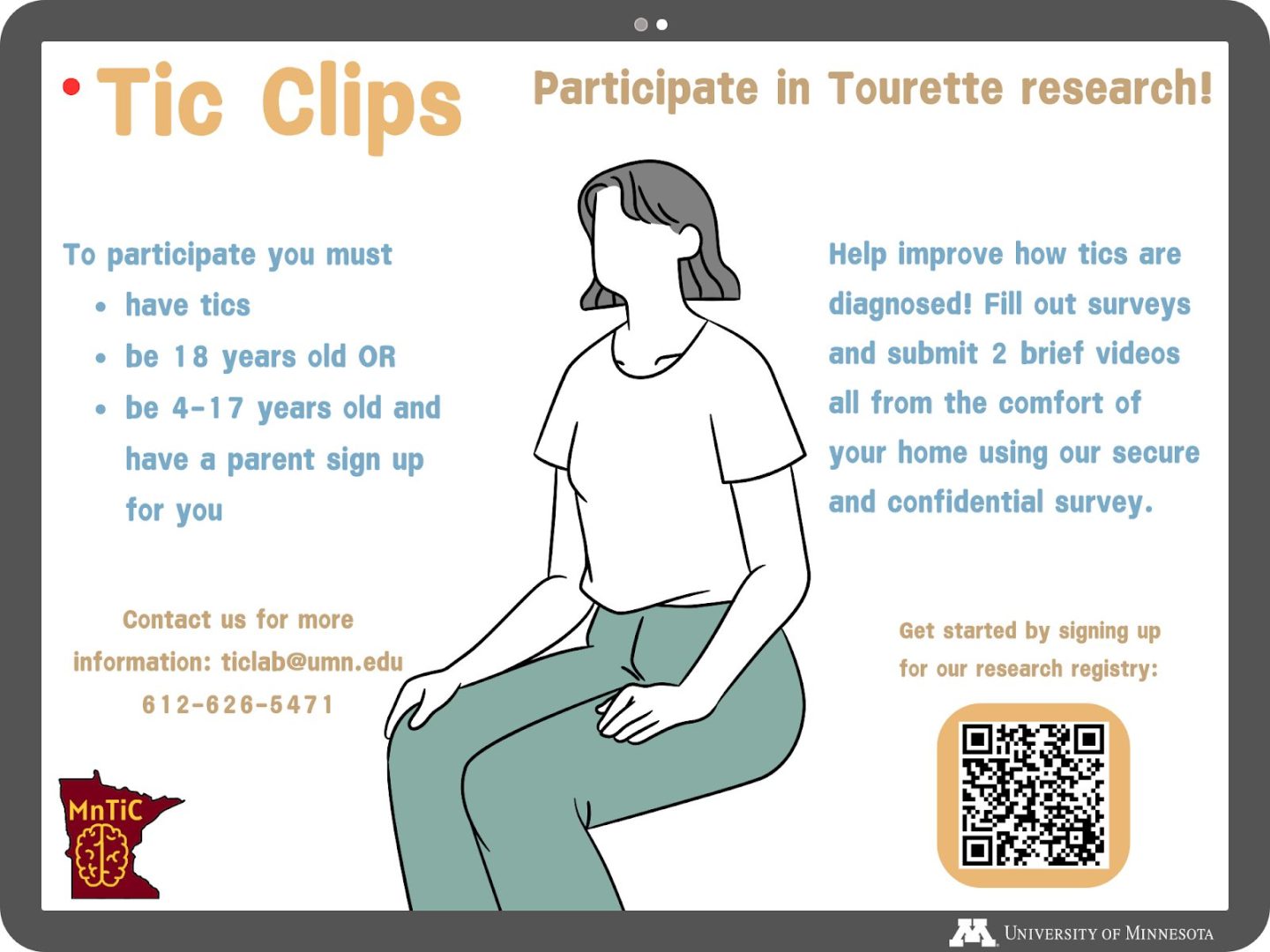
We know that different people experience tics in different ways. By viewing a lot of videos of people having tics, we hope to better understand the variety of tics that exist. We will also get videos from the same people over the course of a year so we can see how tics change. A goal of Tic Clips is to create computer software that can tell the difference between typical movements and tics.
Our hope is that Tic Clips will help us improve the way we identify tics in the future. Right now, doctors figure out if a person has a tic disorder by asking questions and watching the person’s movements. This process has some limitations. For example, different doctors might notice different tics, or a person’s tics might be different in the doctor’s office than at home. One goal of this study is to develop a digital tool that can help us reliably measure tics. Our hope is that a tool like this could improve the healthcare experience of people with tics. Join Tic Clips
Questions? Go to Tic Clips, watch this video, or write to ticlab@umn.edu