
A child who can’t stop moving, a student who makes sounds in a quiet room, a person who seems distracted, disruptive, or defiant.
For many of us, the instinct is to correct.
Stop. Focus. Try harder.
For Julian Fletcher, a program coordinator for the Alberta Tourette OCD Alberta Network at the University of Calgary, compassion doesn’t begin with empathy. It starts with understanding. Without understanding, even well-meaning people cause harm.
For more than five years, Julian has spent his days helping families, teachers, and clinicians make sense of Tourette Syndrome and OCD. Over that time, he has come to believe that most parents, educators, and guardians don’t respond poorly because they’re unkind, but because they don’t understand what they’re seeing.
At times, though, the system itself makes that understanding difficult to build. Schools, often stretched thin and pressed for time, can decline opportunities to help teachers and peers learn their way toward compassion. For Julian, this is one of the hardest parts of the work: prying doors open just wide enough to let understanding in.
The Instinct to Correct
Julian, instantly distinguished by a style best described as stoic realism paired with energetic candour, works with families in the space between knowing a diagnosis exists and understanding what it looks like in daily life.
He knows that this shift in understanding often determines whether a child is met with patience or punishment.
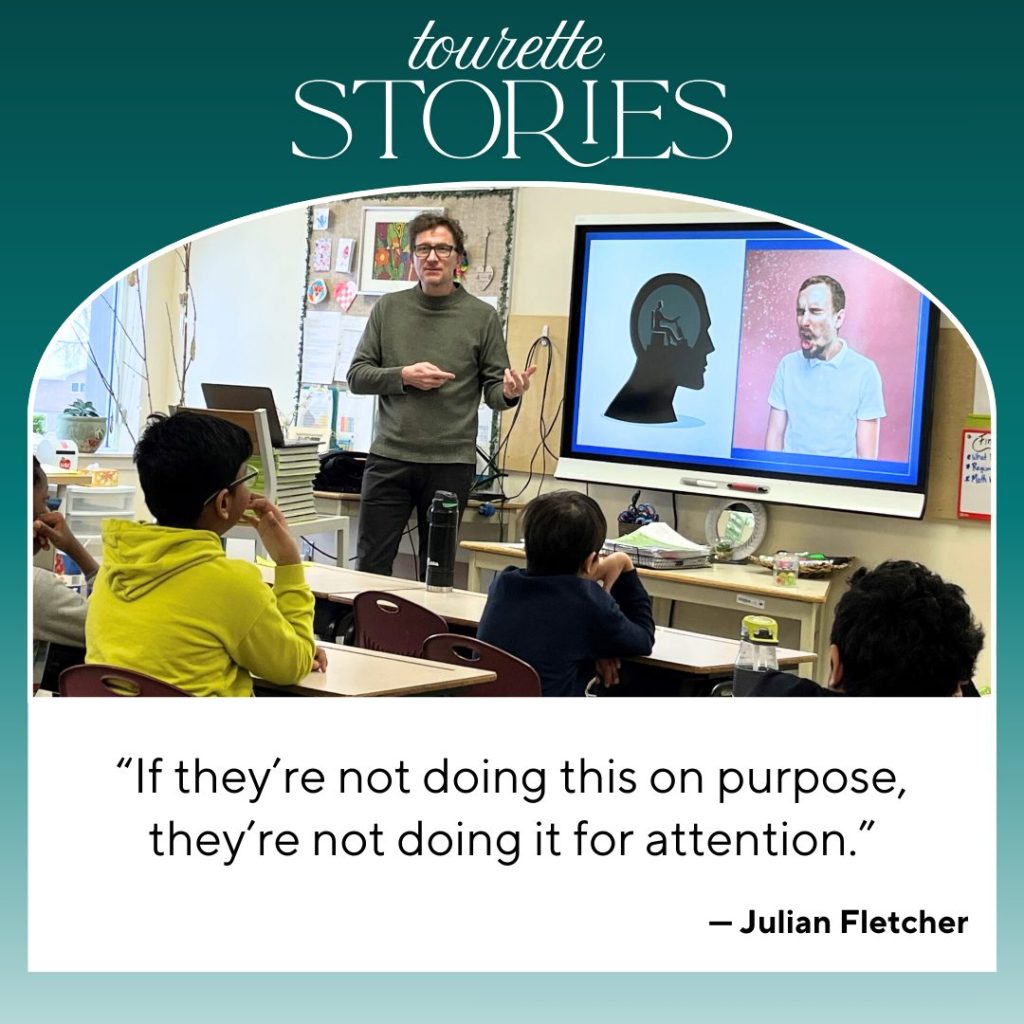
As he puts it, “If they’re not doing this on purpose. They’re not doing it for attention.”
Without that understanding, even gentle corrections can become sources of pressure. Pressure, he explains, almost always makes things worse.
Our instincts, Julian argues, come from what he calls “a void of knowledge.”
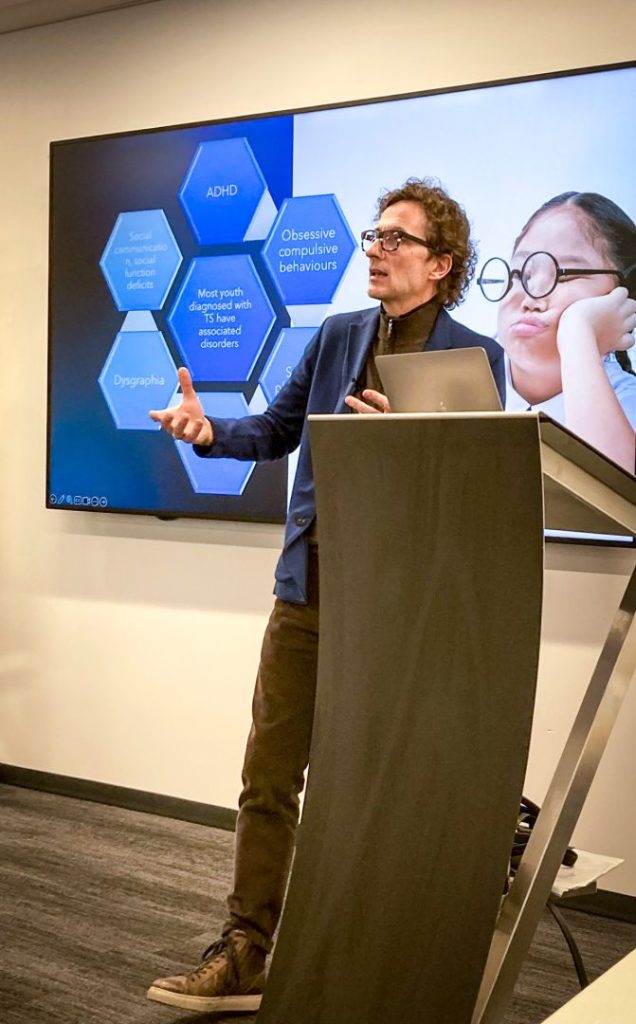
When that void isn’t filled, people react to behaviour rather than context, and judgment rushes in to replace understanding. This insight has shaped the way he educates Albertans: with precision and warmth, clinical rigour delivered through accessible language, and an approach that refuses to separate accuracy from humanity.
In speaking with Julian, it’s difficult not to see that void everywhere.
Across Canada, many young people suffer as much from social misunderstanding as they do from Tourette Syndrome itself. Julian’s work does not cure the condition, but it does something equally vital: it interrupts the stigma that grows in the absence of understanding.
Between Diagnosis and Daily Life
Julian doesn’t diagnose children or prescribe medication. As he puts it, “I’m not there to treat, I’m there to explain.”
In a system where doctors are often in short supply, and even when available, may not have the time or capacity for extended conversation, that distinction matters. Explanation, delivered clearly and compassionately, can change how families experience everything that follows.
“My role starts after the diagnosis,” Julian explains, “when families are trying to make sense of what this means for their lives.”
He meets them at a moment when fear and confusion tend to arrive all at once. Parents come carrying questions that feel urgent and unanswerable: Will my child be bullied? Is this my fault? What happens at school tomorrow? Why can’t they just stop?
Julian is careful to explain that this first conversation isn’t about treatment at all. It’s about well-being. That sense of well-being grows from understanding what Tourette’s actually looks like over time and how to live with its unpredictability. He explains that tics wax and wane, that pressure intensifies them, and that telling a child to stop almost guarantees the opposite result.
Listening to Julian speak, it becomes clear that his work isn’t merely about Tourette Syndrome. It’s about translation. He translates medical language into something human and invisible, neurological effort into something teachers, parents, and peers can recognize and respond to appropriately.
This gift didn’t appear by accident. It was shaped by the years Julian spent as a teacher, explaining language and literature to students across different countries and cultures. Long before he worked in clinics or classrooms as an advocate, he learned how often misunderstanding masquerades as defiance and how clarity, delivered patiently, can change the entire dynamic of a room.
Julian often describes himself, half-jokingly, as “the living embodiment of the resources clinicians used to hand out.” What families actually need, he has learned, isn’t another pamphlet. It’s someone who can sit with them and explain, patiently and repeatedly, what they’re seeing and why it matters.
When translation happens, people don’t need to be instructed to be kinder. Teachers stop correcting and start accommodating. Parents stop blaming themselves and start advocating. Children stop apologizing for brains they didn’t choose.
Julian sees this shift happen not in theory, but in real time in clinics and classrooms in Alberta.
Translating Experience
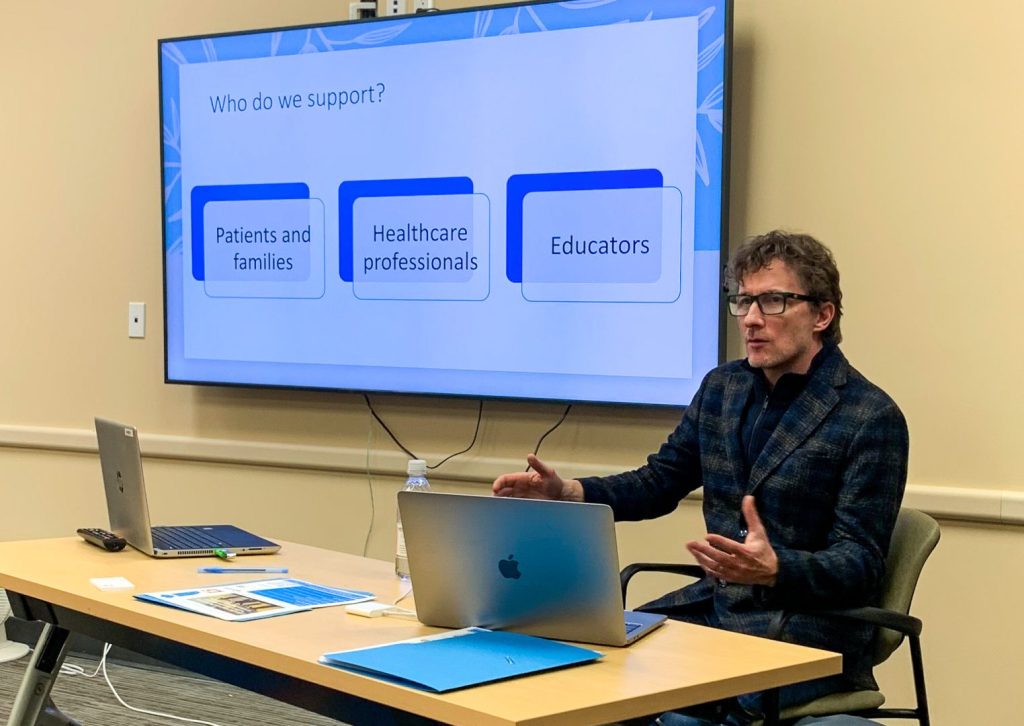
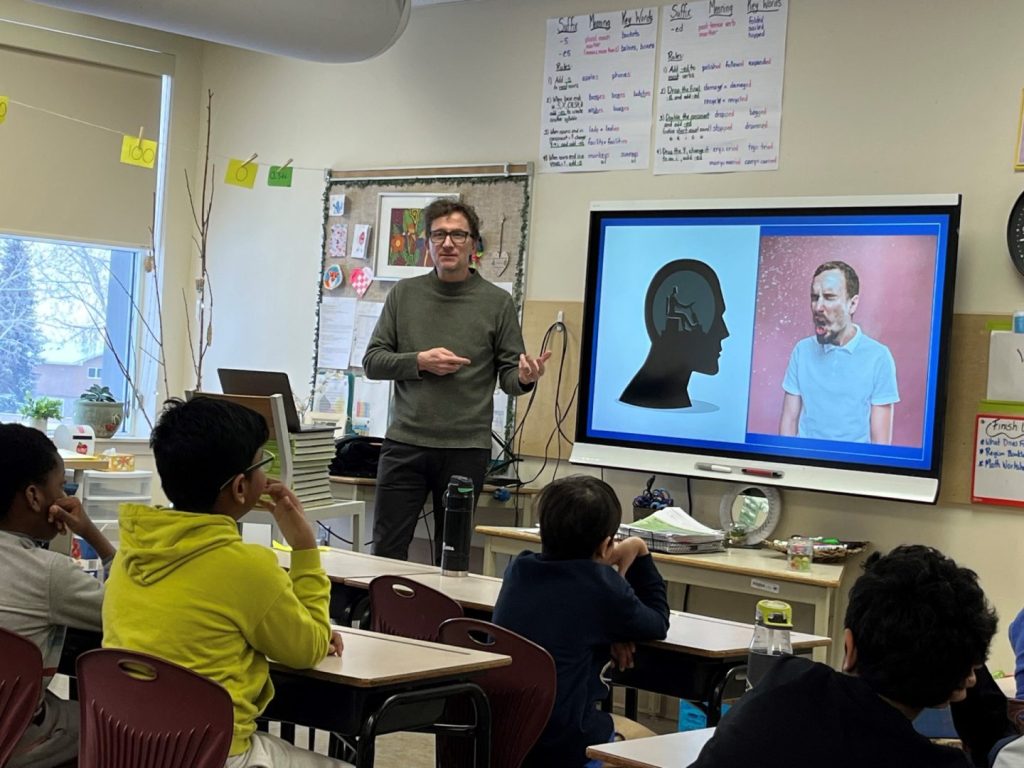
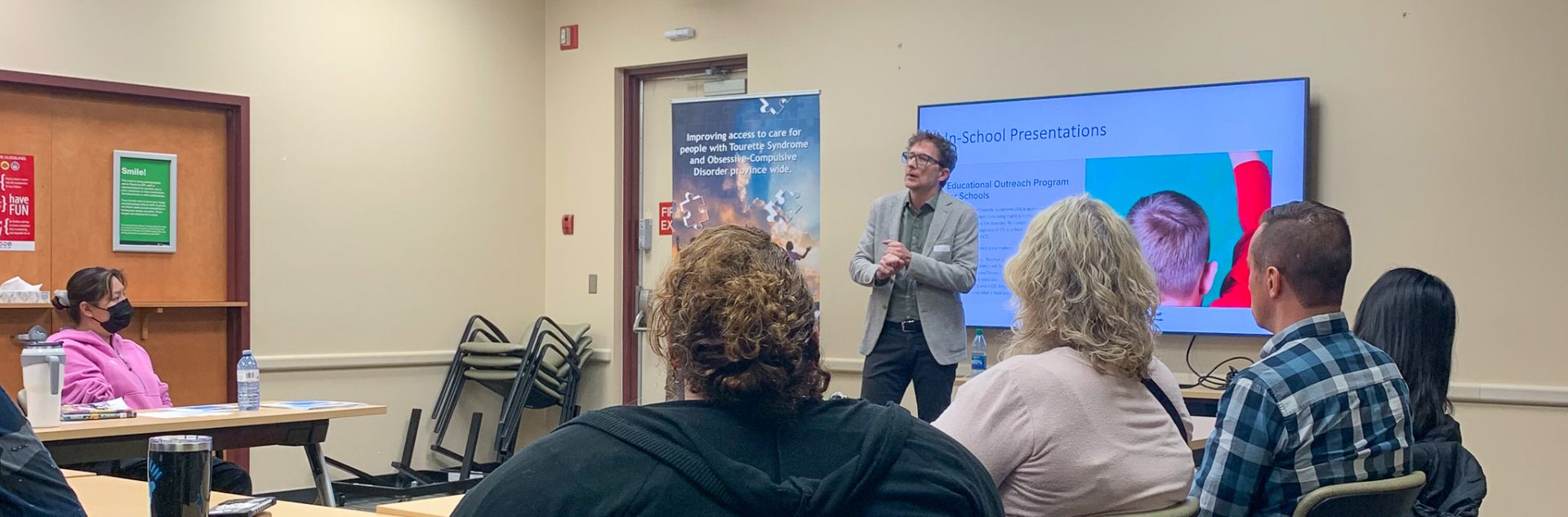
When Julian walks into a classroom or staff room, he doesn’t begin with definitions or slides. He begins with experience.
Participants are asked to copy a poem while their writing hand jerks every time Julian claps.
The task is timed.
Pressure increases.
Interruptions become more frequent.
Then another layer is added: every third word must be crossed out and rewritten.
Then another: sudden distractions that continuously pull attention away.
Frustration builds quickly.
The task becomes nearly impossible.
Only afterward does Julian explain what participants have just experienced: a simulated tic, obsessive-compulsive discomfort, and attention disruption. As he puts it, “I don’t explain it first. I let them experience it, and once they experience it, everything changes.”
In a matter of minutes, adults grasp what hours of explanation often fail to convey. This is what school can feel like every single day for a child with Tourette Syndrome or OCD.
We all intuitively know that lived experience quietly shapes how we see the world and make decisions. Julian’s approach resists turning understanding into a rote phrase. Instead, it becomes a lived memory that lingers.
When a moment of correction arises later, that memory whispers back, reminding the adult what the child with Tourette’s is feeling, even if only briefly. The difference, of course, is that the child feels it all the time.
This lesson reaches far beyond Tourette Syndrome. It points to something fundamental about education itself: that intuitive empathy is not taught through instruction alone, but through experience.
Most importantly, his research has underscored a society-wide benefit of this approach. Julian’s work has been measured to significantly impact healthcare utilization by reducing admissions to emergency and other services, effectively taking a burden off expensive clinicians.
When Doing Less Is the Kindest Response
One of Julian’s simplest lessons is also one of the hardest for people to accept. “Don’t ignore the child,” he says. “Ignore the tic. Speaking to the tic only increases it.”
Julian is careful to stress that the goal is not to stop Tourette’s, but to make it feel so ordinary that it no longer demands comment. It’s about families and schools becoming comfortable enough with minor disruptions that they can be met without reaction.
His point is to look past the harmless tics until you don’t really see them at all. It is a type of mental training that feels akin to mindfulness, and therefore is a skill that not only reduces conflict but also improves the mental well-being of everyone involved.
Julian breaks down a real-life example that acts as a template for us all.
He tells a story of walking through a supermarket and passing a man stacking shelves, making loud vocal sounds. As expected, people stared. Some even looked uncomfortable; others amused in that sort of derisive way that feels like mockery.
Julian, being a seasoned practitioner of what he teaches, walked by calmly, smiled, and continued on. Without further intervention, the man’s tics eased, not because they were controlled, but because they were no longer under scrutiny. Julian saw through the tic and was able to acknowledge the man.
Sometimes, the most humane response isn’t intervention. It’s simply noticing the person.
What Systems Struggle to Do
Julian’s work exposes a quiet truth about our institutions.
He recognized that the problem wasn’t bad teachers or uncaring schools, but systems stretched so thin they struggled to listen at all. Today, one of his greatest challenges is not convincing educators of the importance of understanding Tourette’s, but simply getting the time to be allowed into the room.
But he’s fighting for that time, because, as a translator, he lives as a bridge between educator and advocate.
Schools are not intentionally cruel, but they are overwhelmed. Healthcare systems are not indifferent, but they are overextended. When explanation is absent, discipline and judgment fill the gap.
Julian’s role exists because systems designed in a one-size-fits format don’t have time to explain slowly, patiently, and repeatedly. He exists because families need someone who will listen, translate, and stay present rather than rushing them out the door.
In many ways, he has come to fill a desperately needed voice in the lives of those with Tourette Syndrome and OCD.
The Economic Benefits of Understanding
The challenge of getting into the room may not be the approach, but the way it is framed. When understanding takes root, systems don’t just become more humane, they become more efficient.
Julian’s work quietly disrupts the idea that this is only about compassion for families. Education and healthcare are among the largest public expenditures in Canada, and inefficiency in either system carries real economic cost. When misunderstanding leads to unnecessary disciplinary action, repeated assessments, or preventable emergency visits, the price is paid not only by families, but by institutions already under strain.
Approaches that reduce crisis escalation and improve day-to-day management save time, resources, and capacity across the system.
There is also a longer view to consider.
Providing teachers and schools with the knowledge they need to properly support students with Tourette’s and OCD may feel like an added burden in the short term. But education has always been an investment before it is a return. The question is not whether time spent understanding neurodivergent students costs something; it is whether failing to do so costs more.
When students move from constant correction to meaningful support, the trajectory of their lives can change. Children who might otherwise disengage or underperform are given the chance to develop confidence, skills, and independence. Over time, that shift matters not only in individual outcomes but in workforce participation, productivity, and social contribution. Helping more students move from struggling to thriving strengthens the economic fabric of society as surely as it strengthens its moral one.
Julian’s work reminds us that understanding is not a soft value opposed to efficiency. It is often the condition that makes efficiency possible.
Where to Begin
There is a quiet irony at the heart of Julian’s work.
Institutions struggle to find time for his message, even though it ultimately saves time and makes systems more effective. In that tension, something deeper is revealed about how modern Canadian society operates.
We simply don’t slow down long enough to listen.
Before Julian ever worked with Tourette’s Syndrome and OCD, before he was even a teacher, he was on a very different path. He was building a successful career in media, representing international networks in Eastern Europe, with opportunities that promised wealth and status. By most measures, it was a career people strive for.
But it didn’t mean much to him.
“It would have been deemed a very successful, very well-paid career,” he explains. “But it didn’t really mean that much to me. I didn’t care about driving sales or increasing revenues.”
What Julian discovered, slowly and then unmistakably, was that meaning mattered more than momentum. He was interested in what helps people grow and flourish.
“What mattered to me was speaking to people as people, and helping them see what they were capable of.”
That realization eventually led him into education, and later into the work he does now.
The same instinct runs through everything Julian does today. His work with Tourette’s forces a question most of us would rather avoid: what do we do when someone cannot meet our expectations of “normal”? Do we correct them, exclude them, pathologize them, or do we slow down long enough to understand?
Julian’s answer is quietly radical. When we take the time to explain Tourette’s properly, we aren’t just educating people about a condition. We are teaching patience, humility, and the difference between control and care. In explaining Tourette’s, we end up explaining something much larger than neurology or diagnosis.
We explain what it means to have humanity.
That belief sits at the heart of Julian’s work and aligns closely with the mission of Tourette Canada: to educate, advocate, and build community through understanding.
Through a growing national effort, that work is expanding, reaching more families, classrooms, and communities with the knowledge needed to make life more humane.
Julian’s work reminds us that understanding doesn’t spread on its own. It is carried by teachers who make time, by parents who ask better questions, and by communities willing to learn before they judge.
It begins in ordinary moments, when a sound interrupts a room, when a child moves in a way that draws attention, when our instinct is to correct before we understand.
The invitation, then, is simple, but not easy: pause. Ask what you might be missing.
Choose understanding.